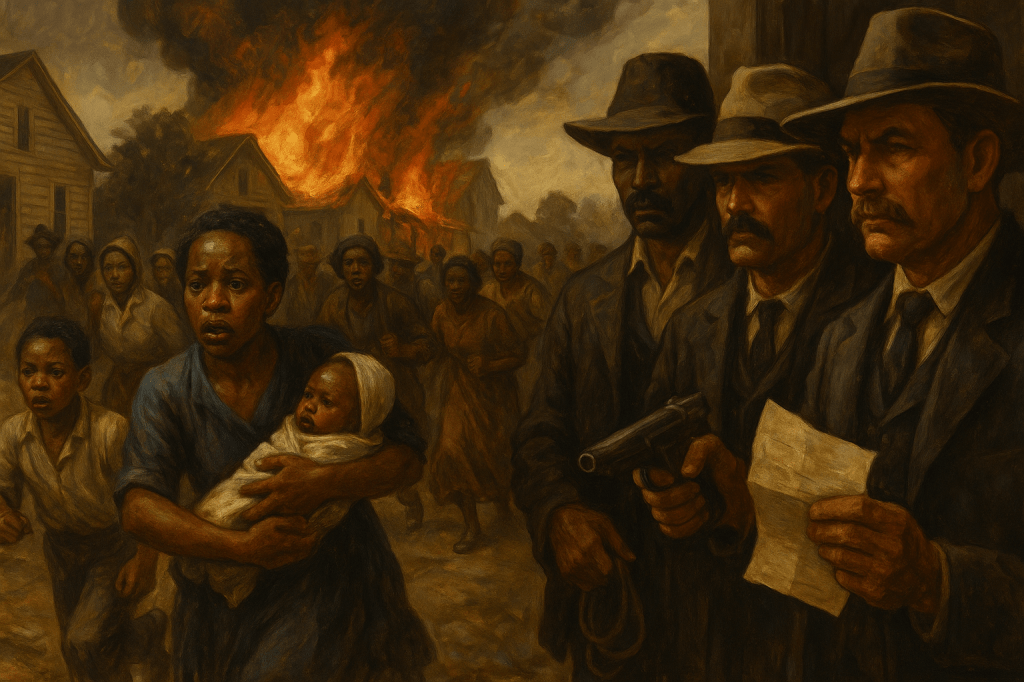
During the Jim Crow era, entire Black communities were systematically forced out of towns and counties through a combination of racist violence, intimidation, and bureaucratic neglect. These expulsions were not simply spontaneous riots but planned campaigns to create all-white communities—using violence to drive people out and denying them the documentation that would prove they ever belonged there.
One of the most infamous examples took place in Forsyth County, Georgia, in 1912. After allegations of a sexual assault involving Black men and a white woman, white mobs launched a coordinated campaign of terror. The Ku Klux Klan and local residents threatened, beat, and destroyed the property of Black families to force them out. Over 1,000 Black residents were expelled, fleeing with only what they could carry. Their farms and homes were abandoned or stolen, and their land records and birth certificates were lost or deliberately destroyed. Local officials did nothing to help them keep vital records that would have proven their birth in Georgia, their property ownership, or their right to return. For decades, their descendants faced enormous obstacles in reclaiming land or even proving ancestral ties to Forsyth County.
A similar story unfolded in Harrison, Arkansas, in 1905 and again in 1909. White residents staged two major waves of violent expulsions that emptied the town of nearly all its Black population. Mobs threatened Black families, burned homes and businesses, and carried out beatings to terrorize them into leaving. In the chaos of escape, many Black residents left behind personal documents, including birth and marriage certificates, deeds, and school records. County governments made no effort to safeguard these vital records, ensuring that returning Black families would have no legal evidence to reclaim their homes or assert their rights. By 1910, Harrison had become a notorious “sundown town,” where Black people were openly warned never to stay overnight.
These expulsions were more than acts of physical violence. They were deliberate strategies to erase Black communities both physically and bureaucratically. By destroying or denying access to birth certificates and other vital records, these towns ensured that Black people would be stripped of their proof of citizenship, property ownership, and belonging. Without those documents, returning was legally and practically impossible.
This history matters urgently today because it exposes how paperwork can be weaponized to deny people their rights. Birth certificates are more than pieces of paper—they are the legal proof of who you are, where you belong, and what rights you have as a citizen. During Jim Crow, denying or destroying those documents was a tool of racial exclusion and enforced poverty.
Understanding what happened in places like Forsyth County and Harrison, Arkansas, forces us to confront how bureaucratic tools have been used to strip people of rights that should have been guaranteed by the Constitution. It’s a reminder that true equality means not just promising rights in theory, but ensuring everyone can actually prove and claim them in practice.
 ClockWorkMuzik